

Less catching up. More focused therapy.
Psyched helps therapists review patient-shared entries, goal-linked moments, interaction patterns, and topics patients have saved for session, so the conversation can start with clearer context.
The therapist dashboard is currently being built with simulated data, and we’re inviting clinicians to help shape what becomes useful before live patient sharing begins.
From between-session moments to session-ready context
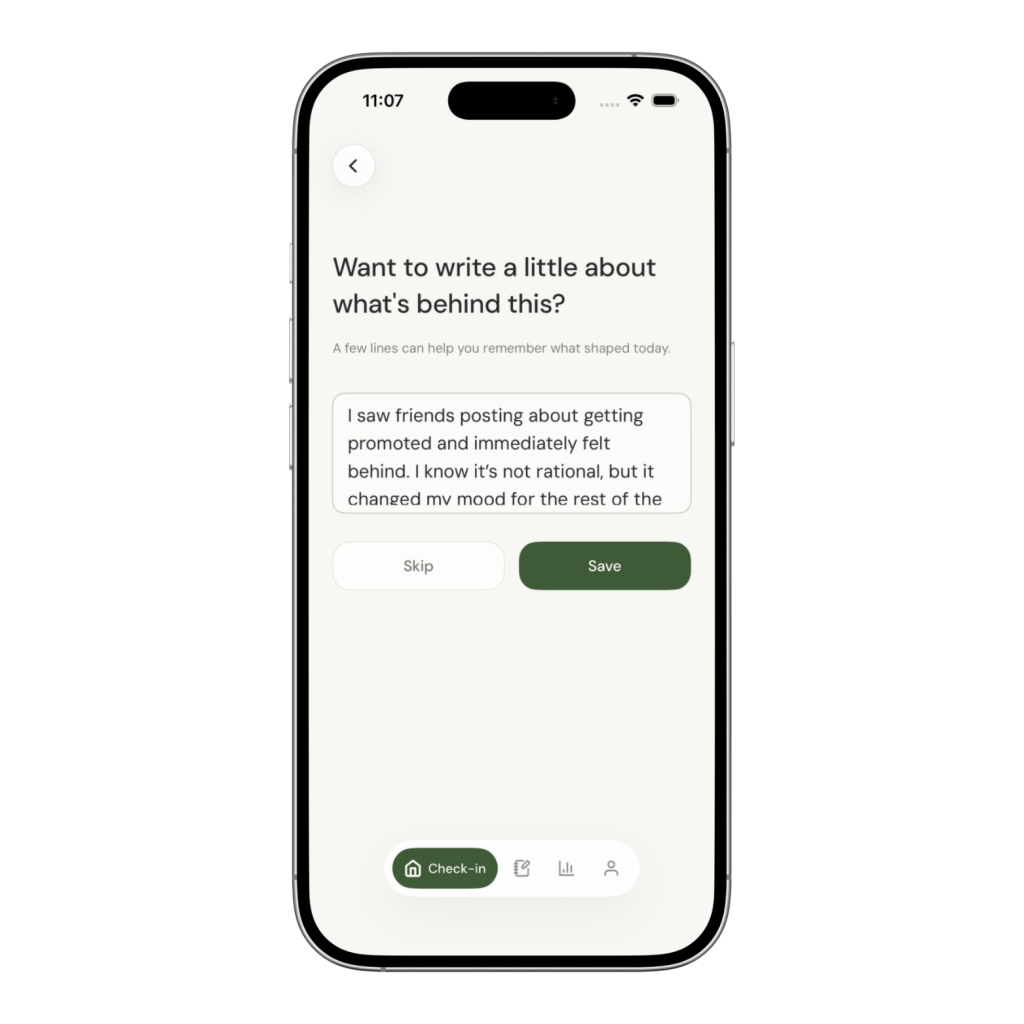
1. Patients capture context
Patients record meaningful interactions, reflections, goals, and moments between sessions.
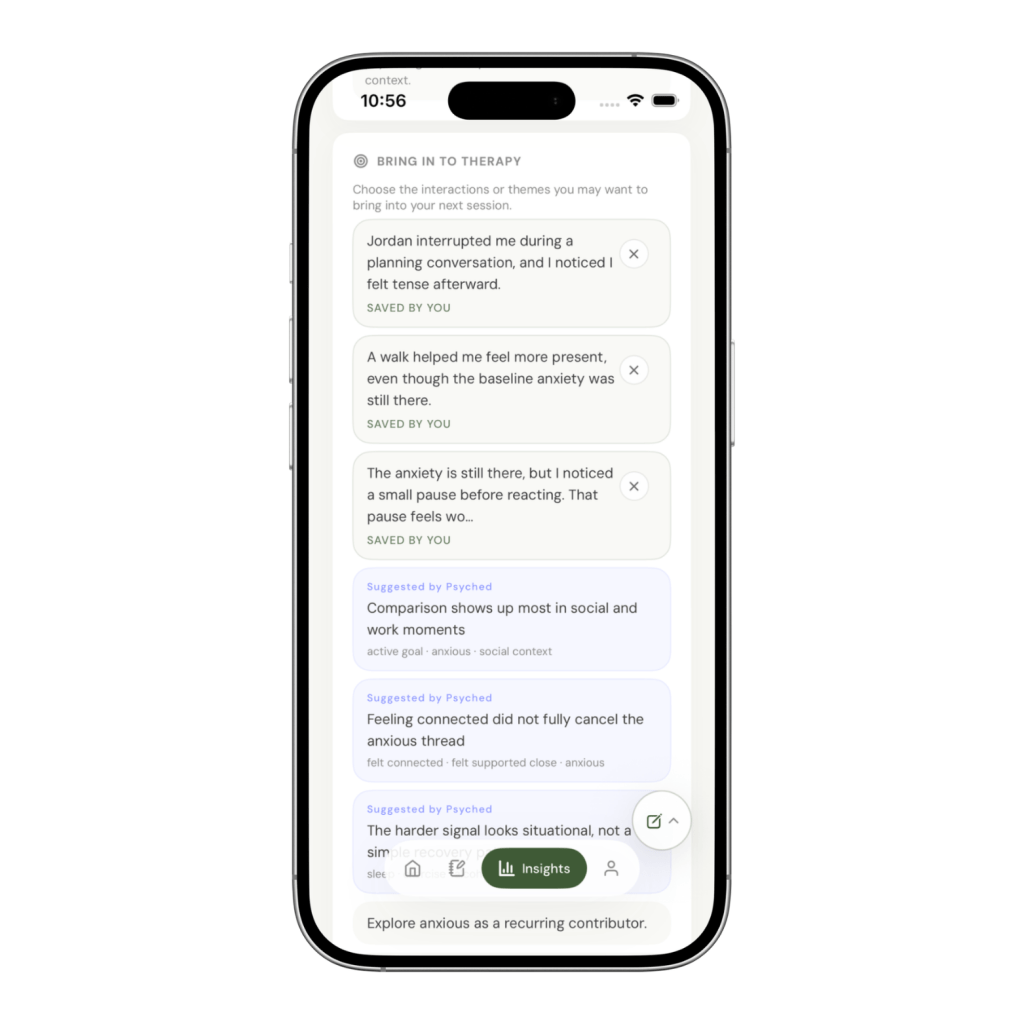
2. Patients decide what matters
Patients review possible patterns and choose what they want to save or bring into therapy.
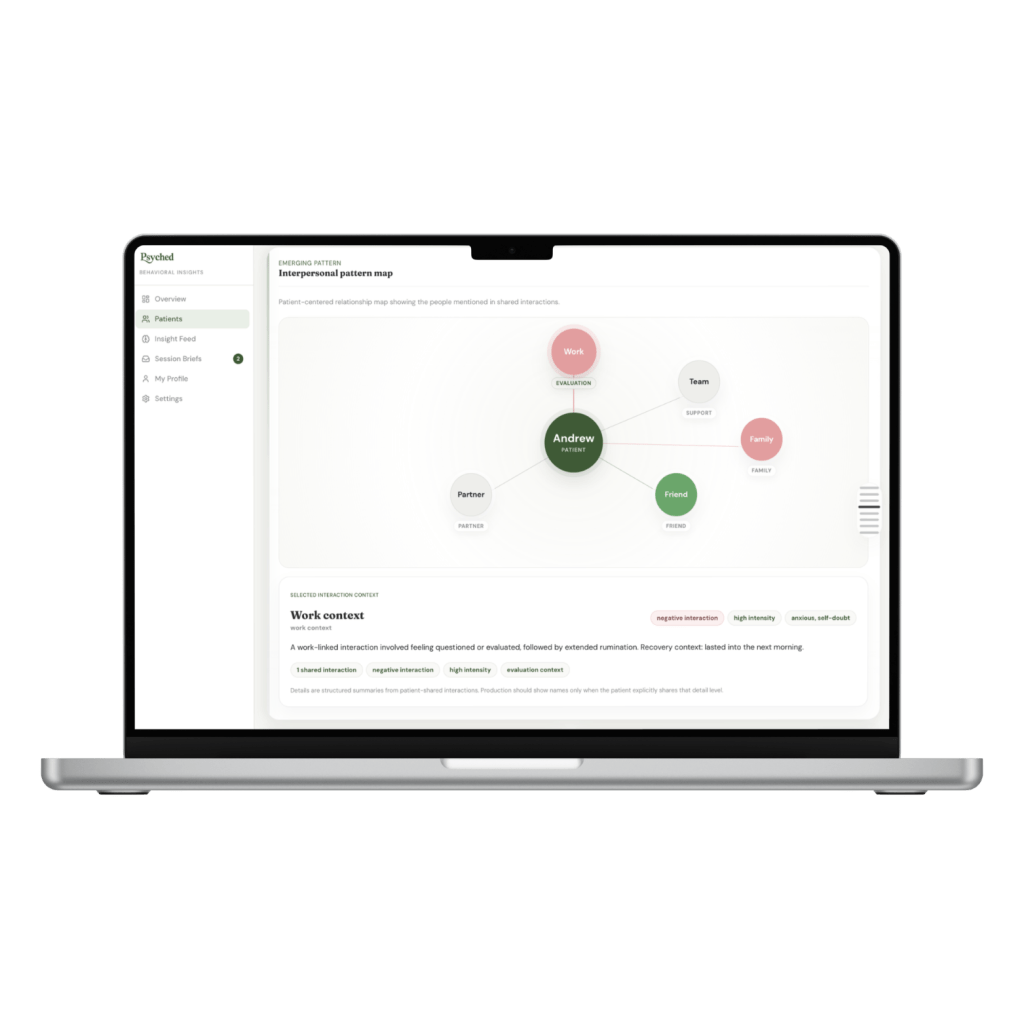
3. Therapists review shared context
Before the session, therapists can review selected topics, goal-linked moments, interactions, and patterns in one place.
A faster read on what changed, what repeated, and what may be worth exploring
Psyched organizes patient-shared check-ins, interactions, reflections, sleep, and therapy-prep selections into focused views for pre-session preparation. It is designed to support clinical judgment—not replace it.
Dashboard in development · Simulated data only
30-second pre-session brief
Start with a concise summary of recent patient-shared activity, reported signals, recurring themes, and topics selected for the next session.
The brief helps therapists orient quickly without reading every entry or reconstructing the full week.
Patterns across time
Explore specific relationships across the patient’s shared data rather than relying on a general trend summary.
Views may include recovery or rumination duration, trigger-to-mood linkage, interpersonal pattern maps, anticipatory distress versus actual outcome, avoidance and goal follow-through, and sleep-related reactivity.
Patient-selected session focus
See the entries, reflections, recurring themes, and interactions the patient has intentionally chosen to bring into therapy.
Psyched can also show where those selections converge with repeated signals, helping therapists identify a clearer starting point for the conversation while preserving patient control.
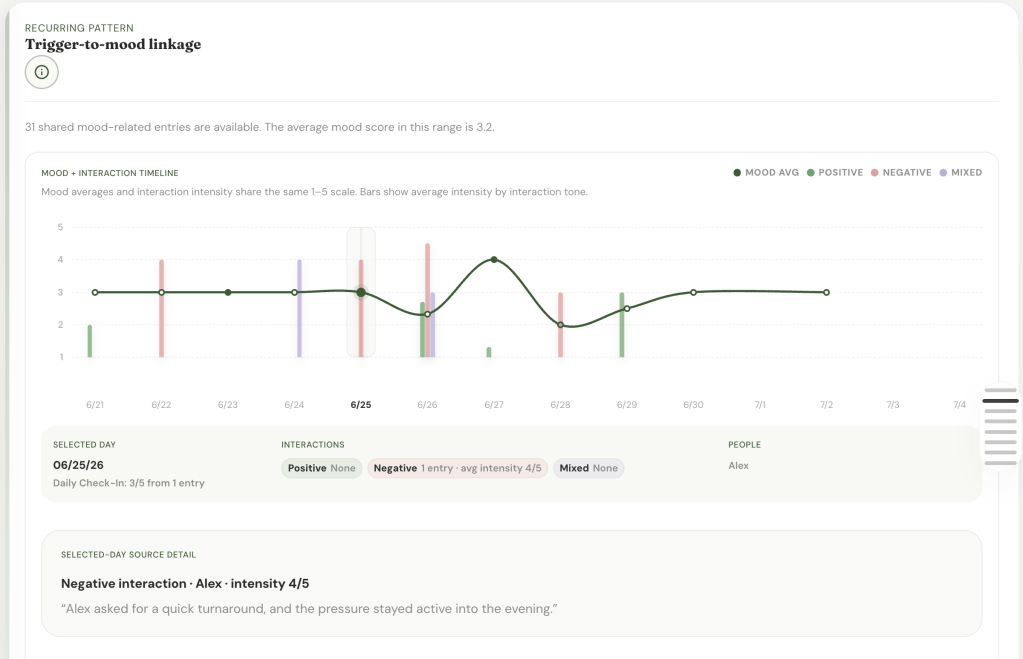
An early dashboard view showing how patient-shared mood check-ins and interactions may be reviewed across time. Therapists can inspect the underlying entries, selected dates, people involved, and reported intensity rather than relying on the chart alone.
Visual draft · Simulated data · Intended to support exploration, not establish causality
Additional insight views in development
Psyched is also exploring focused views that help therapists examine specific patterns within patient-shared information.
Recovery and rumination duration
Explore how long emotional activation appears to remain after meaningful moments or interactions.
Interpersonal pattern maps
Review recurring people, roles, relationship contexts, and interaction themes.
Anticipatory distress vs. actual outcome
Compare what a patient expected before an event with what they reported afterward.
Avoidance and goal follow-through
Explore where avoidance, planned actions, and follow-through appear across time.
Sleep and next-day reactivity
Review whether sleep changes coincide with next-day mood or interaction sensitivity.
Patient-selected therapy-prep convergence
See where topics chosen for session overlap with repeated signals in the shared data.
Built around patient control and behavioral-health privacy
Psyched is being designed around permissioned sharing, role-based access, encryption, auditability, and data minimization. Patients remain in control of what they choose to bring into therapy, and therapists do not automatically receive access to everything a patient records.
The therapist dashboard currently uses simulated data and is not connected to live patient records. Psyched is working toward the technical, operational, and vendor requirements needed for HIPAA-aligned clinical use and is not currently represented as HIPAA compliant.
Patient-controlled sharing · Role-based access · Encryption · Auditability · Simulated data only today

Help shape what becomes useful
We’re inviting therapists to help determine what belongs in the dashboard, what creates unnecessary noise, and how patient-controlled sharing should fit into real clinical workflows.
